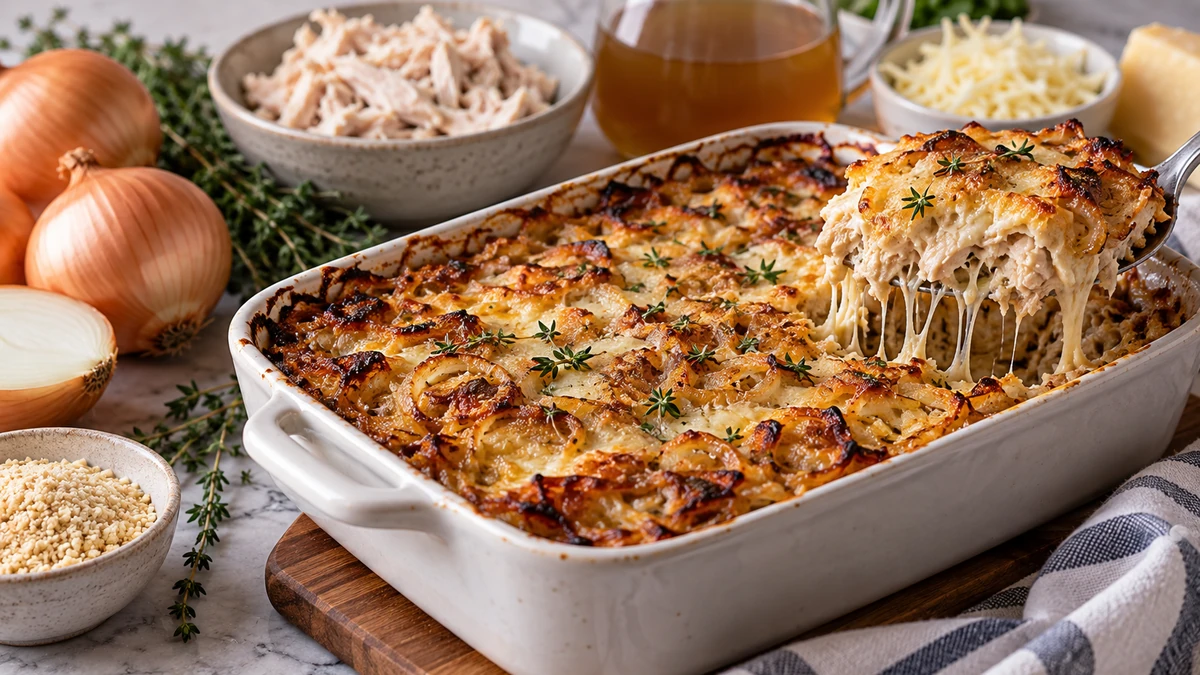
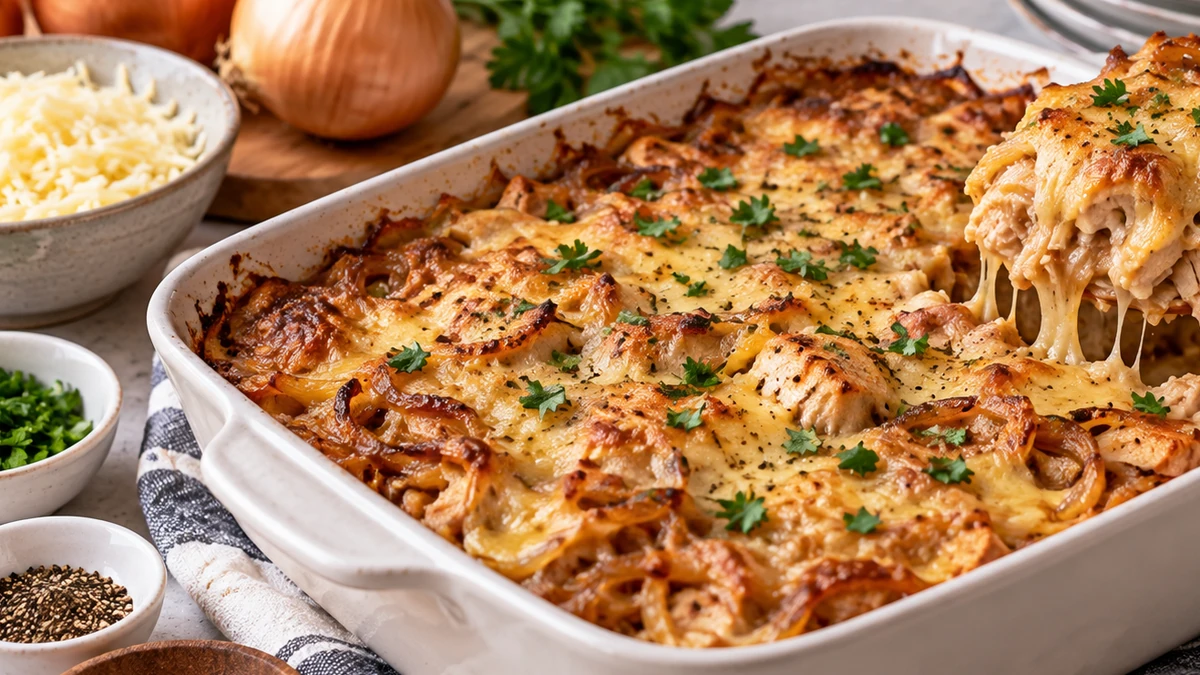
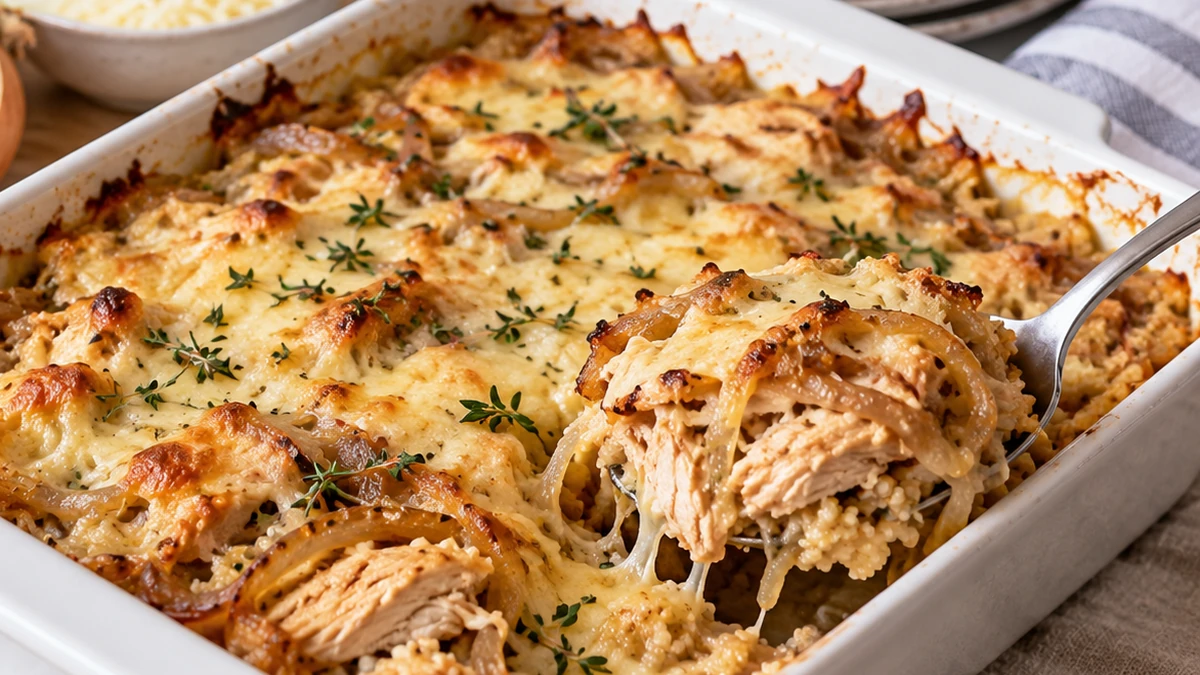
High protein French onion chicken casserole turns the flavors of French onion soup into a practical family dinner with caramelized onions, lean chicken breast, white beans, a blended cottage-cheese sauce, and a browned Gruyère topping. It is creamy and deeply savory without using condensed soup, Rice-A-Roni, or a heavy cream sauce.
The recipe is built around real caramelized onions because that is where French onion flavor actually comes from. The onions cook low and slow until golden, then beef broth, thyme, garlic, and Worcestershire deepen the savory base. Chicken, cannellini beans, and cottage cheese keep the casserole protein-forward, while Gruyère gives the top the nutty flavor people expect from French onion soup.
Why This High Protein French Onion Chicken Casserole Works
It starts with actual caramelized onions. The recipe does not depend on powdered onion soup mix for its main flavor.
Chicken breast carries most of the protein. Two pounds gives each serving a substantial amount of lean protein.
White beans add body and fiber. They disappear into the creamy filling instead of turning the dish into a bean casserole.
Blended cottage cheese replaces a heavy cream base. It keeps the sauce creamy and adds extra protein.
Gruyère is used where it matters most. A moderate layer on top gives classic French onion character without making the whole filling cheese-heavy.
The casserole reheats well. It is a good fit for planned leftovers because the creamy filling stays moist.
Ingredients You’ll Need
Yellow Onions
Use 4 large yellow onions, about 2 pounds total, sliced into thin half-moons. This sounds like a lot, but onions lose a major amount of volume as they caramelize. Four large onions create enough sweet-savory flavor to carry an entire 9-by-13-inch casserole.
Yellow onions are ideal because they brown well and develop a balanced sweetness. Sweet onions also work, but they can make the final flavor noticeably sweeter.
Chicken Breast
Use 2 pounds (907 g) boneless, skinless chicken breast cut into bite-size pieces. Smaller pieces cook quickly in the skillet and distribute evenly through the casserole.
Do not cook the chicken until dry before it goes into the baking dish. Brown it and bring it close to done, then let the oven finish the center to a safe temperature.
Cannellini Beans
One drained can of cannellini beans adds protein, fiber, and a creamy interior that fits naturally into the sauce. Their flavor is mild enough that the caramelized onions and Gruyère still dominate.
Rinse and drain the beans well. Extra canning liquid can make the casserole loose and raise the sodium beyond what the recipe needs.
Cottage Cheese
Use 2 cups of 2% cottage cheese and blend it until smooth before adding it to the filling. Once blended, it behaves more like a light creamy sauce than visible cottage-cheese curds.
This is one of the biggest differences between this version and many French onion casseroles built around condensed cream soup or sour cream. Cottage cheese raises protein while still giving the onions and broth a creamy background.
Gruyère
Use about 5 ounces (142 g) shredded Gruyère. Gruyère has a nutty, savory flavor and browns well, so a modest amount on top is enough to signal classic French onion soup.
Swiss cheese can replace it if needed. The flavor will be milder and the nutrition will change slightly.
Beef Broth, Thyme, Garlic, and Worcestershire
Low-sodium beef broth reinforces the French onion flavor without requiring a canned soup base. Fresh thyme, garlic, black pepper, and a small amount of Worcestershire sauce give the onions more savory depth.
If you need the casserole to be gluten free, use a Worcestershire sauce and broth that are specifically labeled gluten free. Cornstarch is used for thickening instead of wheat flour.
1 (15-ounce) can cannellini beans, rinsed and drained
2 cups (452 g) 2% cottage cheese, blended smooth
5 ounces (142 g) Gruyère cheese, shredded
Instructions
Preheat the oven to 400°F (204°C). Lightly grease a 9-by-13-inch baking dish.
Heat 1 1/2 tablespoons olive oil in a large deep skillet over medium heat. Add the onions and a pinch of the salt. Cook for 25 to 35 minutes, stirring every few minutes, until deeply golden. Add small splashes of broth if the browned bits begin sticking too firmly.
Transfer about two-thirds of the caramelized onions to a bowl. Add the remaining 1/2 tablespoon olive oil to the skillet and increase the heat to medium-high.
Add the chicken, remaining salt, and black pepper. Cook for 5 to 7 minutes, stirring occasionally, until browned on the outside.
Add the garlic and thyme and cook for 30 seconds. Return the reserved onions to the skillet and stir in the Worcestershire sauce and 1 1/2 cups beef broth.
Whisk the cornstarch with the remaining 1/2 cup broth until smooth. Add to the skillet and simmer for 2 to 3 minutes, until lightly thickened.
Turn off the heat. Fold in the cannellini beans and blended cottage cheese.
Transfer to the baking dish and sprinkle the Gruyère evenly over the top.
Bake for 20 to 25 minutes, until bubbling, browned in spots, and the thickest chicken pieces and center of the casserole reach 165°F (74°C).
Rest for 10 minutes before serving.
Notes
Caramelize the onions over medium heat; high heat can burn them before they become sweet and deeply browned.
Use gluten-free-labeled Worcestershire sauce and broth if gluten cross-contact matters.
Cook the finished casserole to 165°F (74°C).
Refrigerate leftovers promptly and use within 3 to 4 days. Reheat leftovers to 165°F.
Nutrition is estimated per 1/8 casserole using representative values for chicken breast, onions, 2% cottage cheese, cannellini beans, low-sodium beef broth, and Gruyère. Brands can change the final values.
Author:Adam Moretti
Prep Time:20 minutes
Cook Time:55 minutes
Category:Dinner
Method:Stovetop and Oven
Cuisine:French-Inspired American
Diet:High Protein, Gluten Free
How to Make High Protein French Onion Chicken Casserole
1. Caramelize the Onions
Heat 1 1/2 tablespoons olive oil in a large deep skillet over medium heat. Add the sliced onions and a small pinch of salt. Cook for 25 to 35 minutes, stirring every few minutes, until the onions are deeply golden and reduced in volume.
If browned bits begin sticking before the onions are ready, add 1 to 2 tablespoons of broth and scrape the pan. This is better than raising the heat and scorching the onions.
2. Brown the Chicken
Transfer about two-thirds of the caramelized onions to a bowl. Add the remaining olive oil to the skillet, increase the heat to medium-high, and add the chicken in an even layer. Season with black pepper and the remaining salt. Cook for 5 to 7 minutes, stirring occasionally, until the outside is browned.
3. Build the French Onion Sauce
Add the garlic and thyme and cook for 30 seconds. Return the caramelized onions to the skillet, then stir in the Worcestershire sauce and 1 1/2 cups of beef broth.
Whisk the cornstarch with the remaining 1/2 cup broth until smooth, then pour it into the skillet. Simmer for 2 to 3 minutes until the liquid lightly thickens. The mixture should look saucy but not soupy.
4. Add Beans and Cottage Cheese
Turn off the heat and fold in the drained cannellini beans. Blend the cottage cheese until smooth, then stir it into the warm filling. Avoid bringing the cottage-cheese mixture to a hard boil after it is added.
5. Assemble the Casserole
Transfer the filling to a lightly greased 9-by-13-inch baking dish and spread it evenly. Sprinkle the Gruyère across the top, making sure some caramelized onions remain visible between the cheese.
If the cheese needs more color after the center is hot, move the dish under the broiler briefly and watch it closely.
7. Rest Before Serving
Let the casserole rest for 10 minutes before spooning it into bowls or plates. The sauce thickens slightly as it stands, which keeps each serving creamy instead of watery.
How to Caramelize Onions Without Burning Them
Good caramelized onions need time more than they need high heat. Medium heat gives the natural sugars time to brown while the onion moisture slowly evaporates.
Slice them evenly. Very thin pieces burn before thicker pieces soften.
Use a wide skillet. More surface area lets moisture escape instead of steaming the onions.
Stir every few minutes, not constantly. The onions need contact with the pan to brown.
Deglaze when needed. A tablespoon of broth loosens browned fond without stopping caramelization.
Stop when they are deep golden, not black. Burned onion turns bitter and can dominate the entire casserole.
Why This Version Uses No Condensed Soup
Condensed soups make casseroles fast, but they can also push sodium high and flatten the onion flavor because most of the sauce comes from one packaged ingredient. This recipe builds the sauce from caramelized onions, broth, blended cottage cheese, and a little cornstarch.
The result is still creamy, but the flavor is easier to control. You can taste the onions, thyme, beef broth, and Gruyère separately instead of having them disappear into a canned cream-soup base.
Why Add White Beans?
Cannellini beans are not part of traditional French onion soup, so they are used carefully here. The goal is not to make a bean casserole; it is to add a mild ingredient that contributes protein, fiber, and creamy texture without competing with the onions.
One drained can spread across eight servings is enough to improve the nutrition profile without dominating the dish. If you strongly dislike beans, you can leave them out, but the listed protein, fiber, calories, and carbohydrates will no longer match.
Make-Ahead Instructions
You can caramelize the onions up to 2 days ahead and refrigerate them in a covered container. You can also assemble the full casserole earlier in the day, cover it, and refrigerate until dinner.
If baking straight from the refrigerator, add roughly 5 to 10 minutes to the oven time and confirm the center reaches 165°F before serving. Keep the Gruyère topping on the casserole during refrigeration; it does not need to be added at the last minute.
For individual portions, the microwave is convenient. Add a teaspoon of broth or water before reheating if the sauce has become very thick. For several servings at once, cover the baking dish and warm it in a 325°F oven until the center reaches 165°F.
Freezing is possible, but the cottage-cheese sauce can become slightly grainier after thawing. For the best texture, use the casserole as a refrigerated meal-prep dish rather than a long-term freezer meal.
Gluten-Free Option
The recipe uses cornstarch instead of flour, so the main points to verify are the broth and Worcestershire sauce. Choose products carrying a gluten-free claim when cross-contact matters.
No bread, baguette, pasta, or fried-onion topping is used in the primary recipe. That keeps the texture creamy and onion-forward while making a gluten-free version much easier than many French onion casseroles.
Variations and Substitutions
Use Rotisserie Chicken
Use about 6 cups shredded cooked chicken and skip the browning step. Add the chicken after the sauce thickens. Rotisserie chicken can be much higher in sodium, so reduce added salt and check the label.
Use Swiss Cheese
Swiss cheese is the easiest Gruyère substitute. It melts well and keeps the same general flavor direction, although Gruyère tastes nuttier and more complex.
Add Mushrooms
Sliced cremini mushrooms work well with caramelized onions. Brown 8 ounces of mushrooms after the onions are removed, then proceed with the chicken. Cook off their moisture before building the sauce.
Make It Lower Carb
Leave out the cannellini beans and add 3 cups cauliflower florets or sliced mushrooms instead. The casserole will be lower in carbohydrates, but also lower in fiber and slightly lower in protein.
FAQ about High Protein French Onion Chicken Casserole
How Much Protein Is in One Serving?
One of eight servings is estimated to provide about 42 grams of protein. Chicken breast provides most of it, while cottage cheese, cannellini beans, and Gruyère add smaller amounts.
Can I Use Pre-Caramelized Onions?
Yes, if they are simply onions cooked with oil or butter and not packed in a very sweet sauce. You need about 2 1/2 to 3 cups cooked caramelized onions for this casserole.
Can I Make High Protein French Onion Chicken Casserole Without Cottage Cheese?
Yes, but the protein and texture change. Plain Greek yogurt can work if it is stirred in off the heat, or you can use a traditional cream sauce. The primary nutrition estimate is based on blended 2% cottage cheese.
Does This Casserole Need Bread?
No. The primary version intentionally skips the bread layer so the onions, chicken, beans, and creamy sauce stay central. If you want the toasted-bread element of French onion soup, serve a small piece of crusty bread on the side.
Can I Freeze It?
You can, but dairy-based sauces sometimes become grainy after thawing. Refrigerated leftovers have the best texture. If freezing, cool completely, wrap tightly, thaw overnight in the refrigerator, and reheat to 165°F.
Can I Use Chicken Thighs?
Yes. Boneless, skinless chicken thighs stay very tender and work well with caramelized onions. They contain more fat than chicken breast, so the nutrition will differ.
Final Tips
For the best high protein French onion chicken casserole, give the onions enough time to caramelize, keep the sauce thick but not dry, blend the cottage cheese smooth, and stop cooking the chicken as soon as the finished casserole reaches 165°F.
That gives you a genuinely French-onion-style dinner with real caramelized onions, browned Gruyère, creamy sauce, and about 42 grams of protein per serving—without relying on condensed soup.
Reviewed recipe options
Make this recipe fit me
Choose one of seven popular diet options. NutriMatch will confirm whether the recipe already fits, show a reviewed adaptation when available, or recommend recipes that match your choice.
Please choose a diet first.
Reviewed Dairy-Free adaptation
Dairy-Free French Onion Chicken Casserole
Use the reviewed substitutions below to prepare a Dairy-Free version while keeping the original recipe's basic method.
Check: Check every packaged substitute, sauce, seasoning, and topping for milk ingredients and the cross-contact information you need. The adapted nutrition differs from the published recipe; recalculate it before relying on the original high-protein, keto, or low-carb claim.
Use these reviewed changes with the original ingredient quantities and instructions above. The original recipe card stays unchanged.
Recipe details, product formulas, and cross-contact information can change. Confirm current labels and use professional guidance when medically necessary.
Already a reviewed match
This recipe already fits Gluten-Free.
No changes are needed based on its reviewed NutriMatch classification. Check the complete ingredients, product labels, and serving details for your own needs.
Recipe details, product formulas, and cross-contact information can change. Confirm current labels and use professional guidance when medically necessary.
Already a reviewed match
This recipe already fits High Protein.
No changes are needed based on its reviewed NutriMatch classification. Check the complete ingredients, product labels, and serving details for your own needs.
Recipe details, product formulas, and cross-contact information can change. Confirm current labels and use professional guidance when medically necessary.
Not available for this recipe
This recipe cannot currently be made Keto with a reviewed adaptation.
NutriMatch will not guess at substitutions. Try one of these recipes that is already reviewed for your choice.
Recipe details, product formulas, and cross-contact information can change. Confirm current labels and use professional guidance when medically necessary.
Not available for this recipe
This recipe cannot currently be made Low Carb with a reviewed adaptation.
NutriMatch will not guess at substitutions. Try one of these recipes that is already reviewed for your choice.
Recipe details, product formulas, and cross-contact information can change. Confirm current labels and use professional guidance when medically necessary.
Not available for this recipe
This recipe cannot currently be made Vegan with a reviewed adaptation.
NutriMatch will not guess at substitutions. Try one of these recipes that is already reviewed for your choice.
Recipe details, product formulas, and cross-contact information can change. Confirm current labels and use professional guidance when medically necessary.
Reviewed Vegetarian adaptation
Vegetarian French Onion White Bean Casserole
Use the reviewed substitutions below to prepare a Vegetarian version while keeping the original recipe's basic method.
Add the beans after the onions and sauce are finished instead of browning them like chicken.
Check: Check broths, sauces, seasonings, cheeses, and meat substitutes for animal-derived ingredients that matter to you. The adapted nutrition differs from the published recipe; recalculate it before relying on the original high-protein, keto, or low-carb claim.
Use these reviewed changes with the original ingredient quantities and instructions above. The original recipe card stays unchanged.
Recipe details, product formulas, and cross-contact information can change. Confirm current labels and use professional guidance when medically necessary.