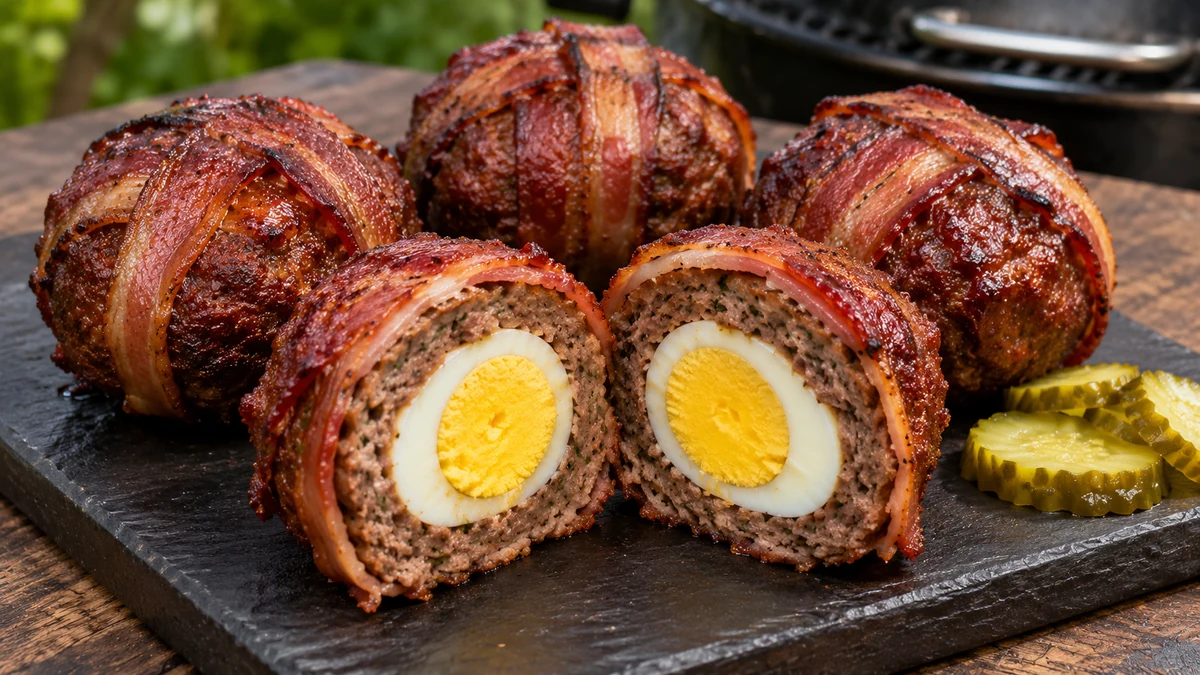
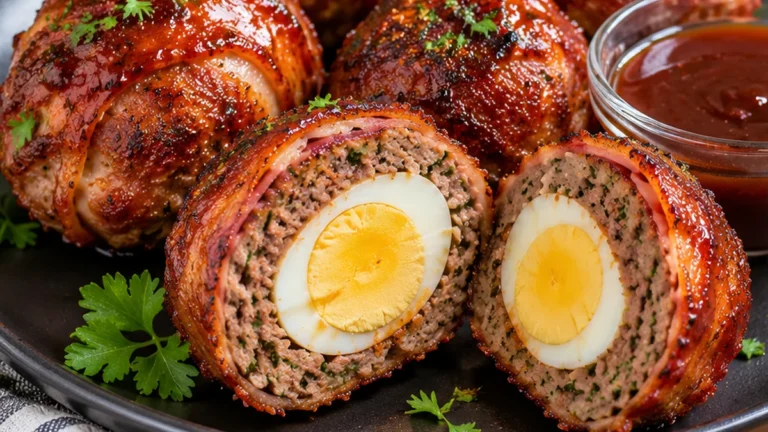
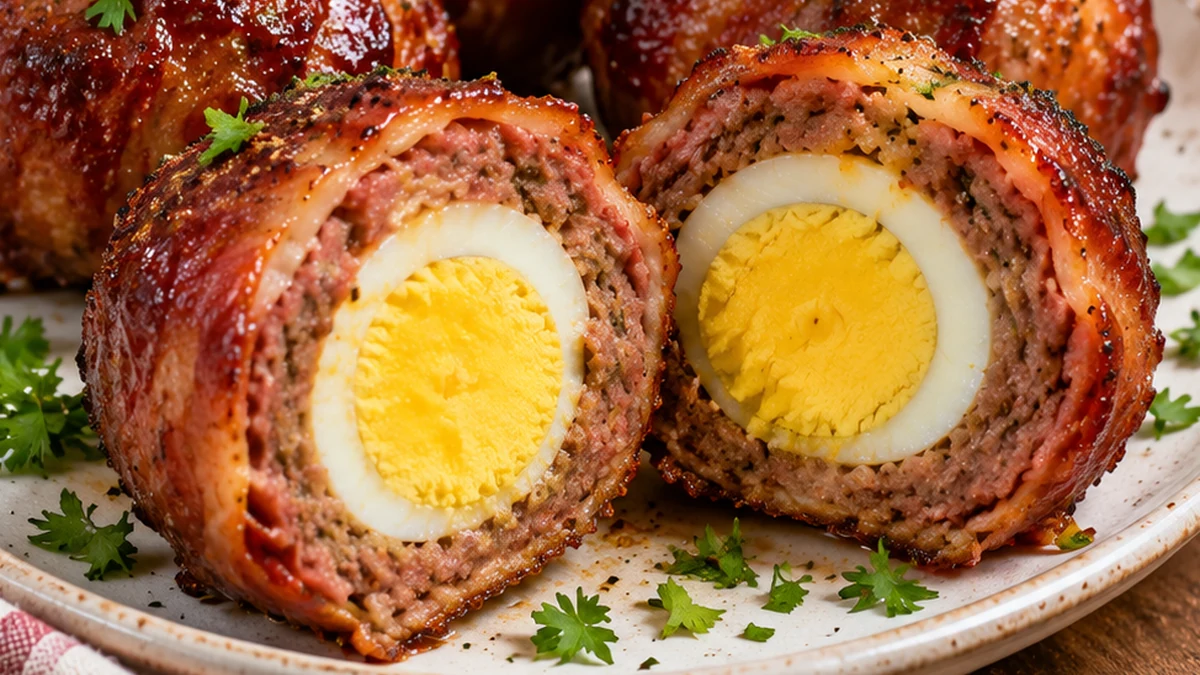
Smoked dragon eggs are hard-boiled eggs covered in seasoned ground beef, wrapped in bacon, and cooked over indirect smoke until the beef reaches a safe temperature. Cut one open and you get a visible ring of smoky bacon, savory beef, egg white, and yellow yolk. These oversized BBQ bites make an attention-grabbing cookout appetizer, but the method is straightforward when you keep the meat layer even.
This version makes six smoked dragon eggs using 90/10 ground beef, regular-cut bacon, and a small brush of barbecue sauce near the end. Plan on roughly 2 hours and 40 minutes from start to finish, including cooking the eggs and resting the smoked bites. You will need a covered smoker or charcoal grill that can hold 250°F with indirect heat and a quick-reading food thermometer.
Table of Contents
What Are Smoked Dragon Eggs?
Think of them as a smoked, bacon-wrapped relative of a Scotch egg. A Scotch egg traditionally places an egg inside seasoned sausage and cooks it with a breadcrumb coating; this BBQ version skips the breading, uses ground beef, and adds bacon before smoking. The name refers to the dramatic layers you see after slicing, not to any special egg variety or hot-pepper filling.
Do not confuse these with armadillo eggs. Smoked armadillo eggs usually begin with a stuffed jalapeño, rather than a real cooked egg, wrapped in sausage or ground meat and then bacon. Smoked dragon eggs have an actual hard-boiled egg in the center. For other party bites that take less time, explore our keto appetizers collection.
Why This Smoked Dragon Eggs Recipe Works
Each hard-boiled egg provides a stable center, so the beef can be shaped evenly around it without raw yolk leaking out.
A thin, continuous layer of 90/10 ground beef cooks more predictably than a thick or uneven shell.
Two strips of regular-cut bacon help cover the beef while allowing rendered fat to drip away.
Indirect heat at 250°F develops smoke flavor without putting the bacon directly over a flame.
A final light glaze adds shine without making the entire batch overly sweet.
The important finish line is 160°F in the thickest beef layer, measured with a thermometer—not an assumed smoking time or bacon color.
Smoked Dragon Eggs Ingredients
For six smoked dragon eggs, start with 6 large eggs and 1½ pounds (680 g) 90% lean ground beef. Divide the meat into six equal four-ounce portions. You also need 12 strips regular-cut bacon, about two per piece. Regular-cut slices overlap more neatly than very thick bacon, which can remain chewy by the time the beef is done.
Season the beef with 1 teaspoon smoked paprika, 1 teaspoon garlic powder, ½ teaspoon onion powder, ½ teaspoon black pepper, and ¼ teaspoon fine salt. For a finish, measure 2 tablespoons barbecue sauce for the entire batch. Choose a sauce you like and check the label if you track added sugar, sodium, or gluten; sauces can differ widely between brands. A tablespoon of chopped parsley or chives is an optional garnish, not part of the nutrition calculation.
Which ground beef is best?
Use 90/10 beef for a practical balance between moisture and fat. Very fatty beef can shrink substantially and split its seams, while extremely lean ground beef can become dry after a long smoke. If you change the beef-to-fat ratio, both the cooking behavior and the estimated calories change. Keep the meat cold while working and mix gently: compacting or kneading it hard creates a dense, springy layer.
Do the eggs have to be hard-boiled?
Hard-boiled eggs are the easiest and most reliable option for this smoked dragon eggs recipe. Their whites hold their shape while you wrap the beef. A soft-boiled center is more delicate, and the long cook used for ground beef will usually continue firming the yolk anyway. For a predictable first attempt, begin with fully cooked, cooled, peeled eggs.
Equipment and wood choice
Use a smoker or covered grill set for indirect cooking, a small pan for the eggs, a mixing bowl, a tray, and a fast-reading meat thermometer with a narrow probe. Apple, cherry, or mild hardwood smoke works well with bacon; use the wood your smoker manufacturer permits. The USDA Food Safety and Inspection Service recommends monitoring both smoker air temperature and food temperature; it describes a smoking range of 225–300°F.
How to Make Smoked Dragon Eggs
Step 1: Boil, cool, and peel the eggs
Bring a pot of water to a boil, lower in six large eggs carefully, and maintain a gentle boil for about 11 to 12 minutes until hard-cooked. Transfer them to cold or ice water to stop the cooking. Once cool enough to handle, peel them and pat the surfaces dry. Moisture makes the raw beef harder to press against the egg, so do not skip the drying step.
Step 2: Mix and divide the ground beef
Combine the 1½ pounds of beef with smoked paprika, garlic powder, onion powder, black pepper, and the ¼ teaspoon salt. Mix lightly just until the seasoning is dispersed. Split the mixture into six equal portions—about 4 ounces each. Flatten one portion between clean hands or on parchment into a thin oval roughly ¼ inch thick. Use a fresh, clean working surface after handling the raw meat.
Step 3: Seal the eggs inside the beef
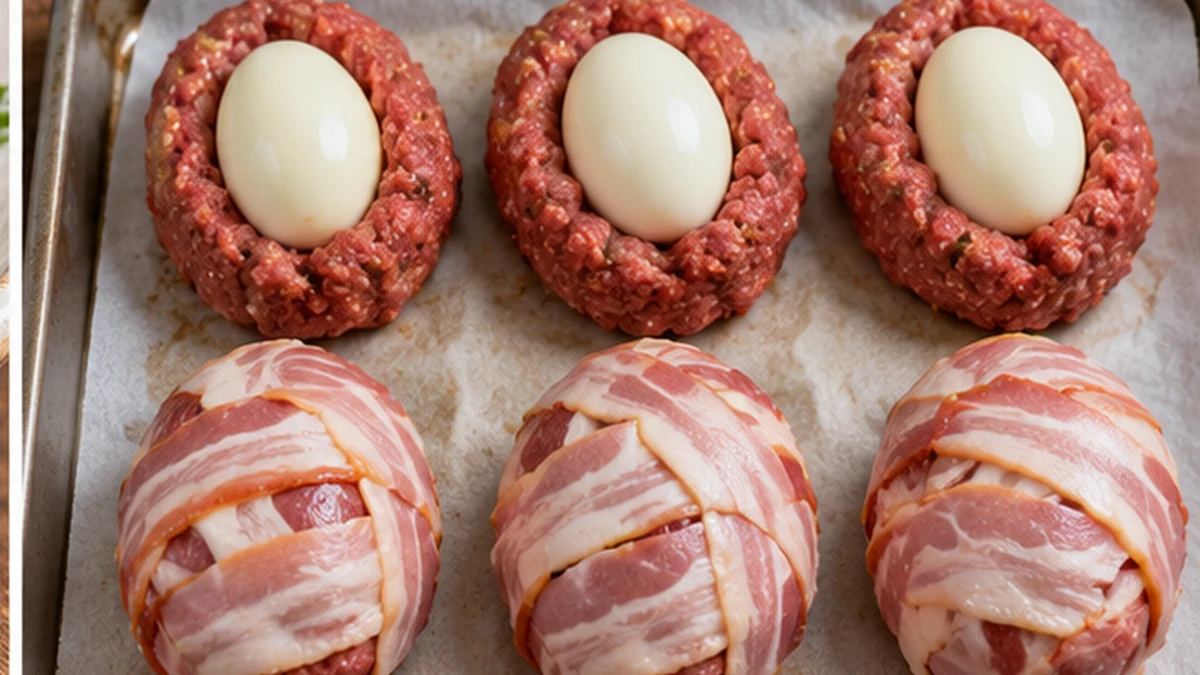
Set a peeled egg in the center of a beef oval. Fold the meat around it and pinch the seams until no egg white is showing. Smooth the surface to an even thickness, particularly near the ends. Repeat with the remaining eggs. A thin, unbroken meat layer helps the outside finish without leaving a thick, undercooked area beside the egg.
Step 4: Wrap with bacon and preheat the smoker
Wrap each beef-covered egg with two regular-cut bacon strips. Start each strip at an angle, overlap the ends, and position the final seam underneath. If a strip is unusually short, use a small wooden toothpick to hold it in place and remember to remove the pick before serving. Meanwhile, preheat your smoker or indirect-heat covered grill to 250°F. Keep the eggs refrigerated if the smoker is not yet ready.
Step 5: Smoke over indirect heat
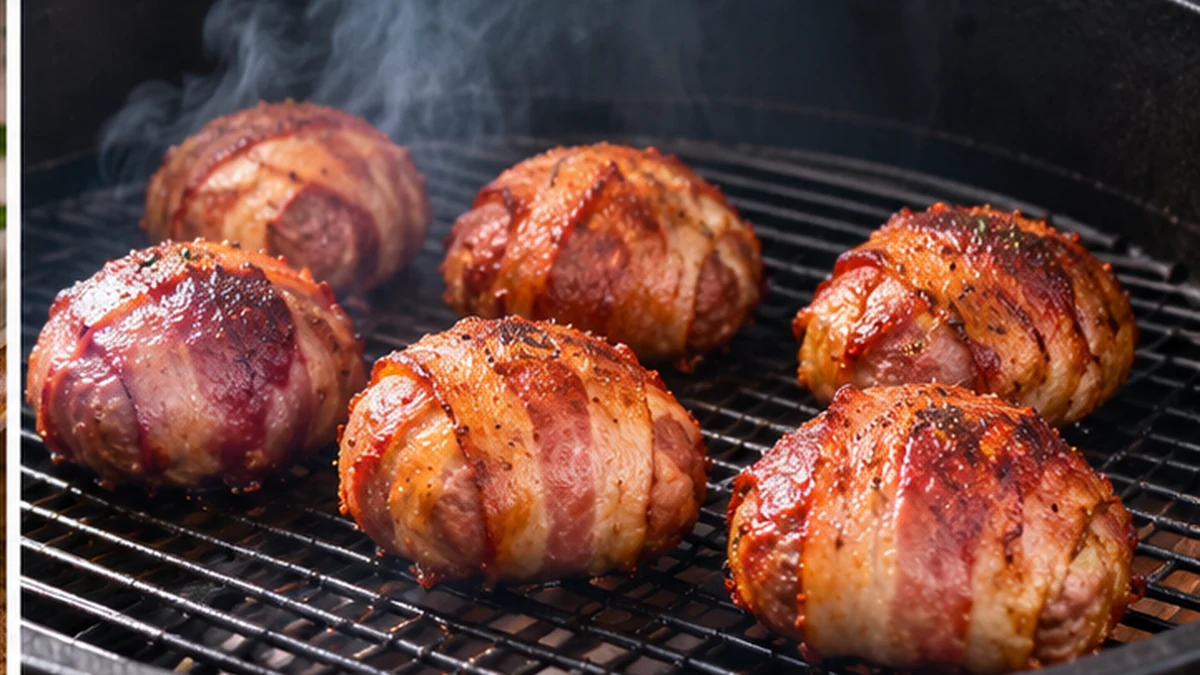
Place the six bacon-wrapped eggs directly on a clean grill grate with a little space between them. Close the lid and smoke at 250°F for approximately 90 to 120 minutes, depending on their size and smoker performance. Start checking near 90 minutes, but do not remove them solely because the timer ended. Insert a thin thermometer probe from the side so the sensing tip is inside the thickest part of the beef layer, not in the already-cooked egg. Check more than one egg.
Step 6: Verify 160°F, glaze, and rest
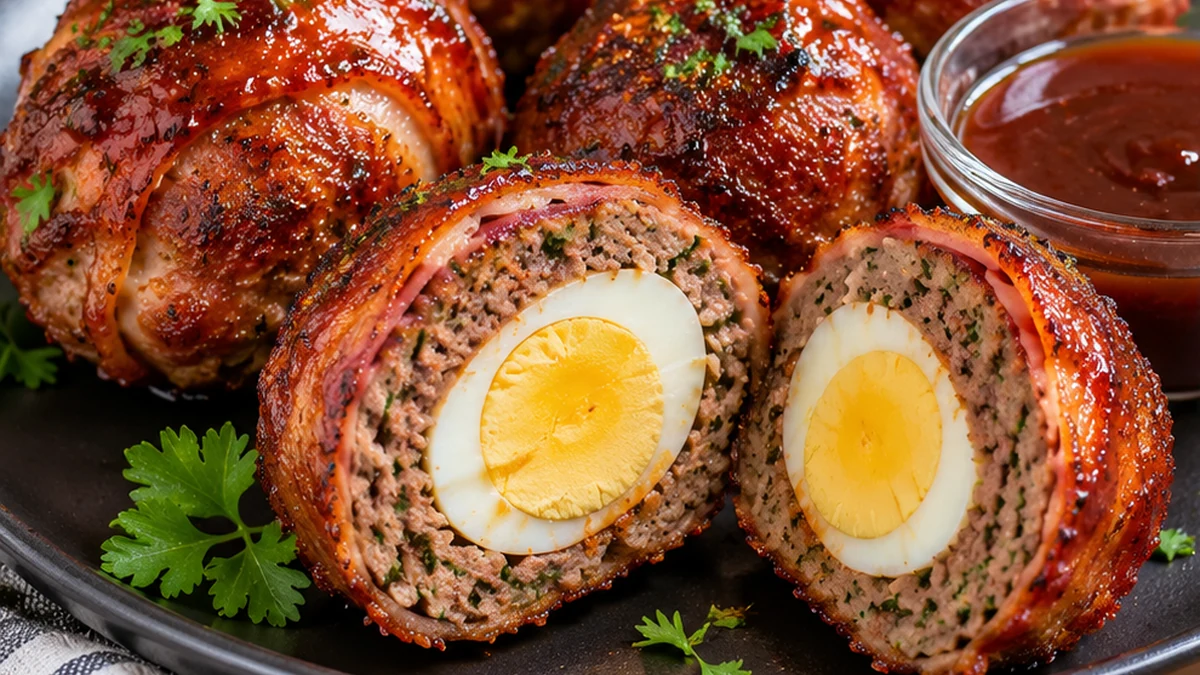
The ground beef must reach 160°F (71°C) throughout, according to the FoodSafety.gov safe temperature chart. When the beef is close to done, lightly brush the outside with the measured two tablespoons of barbecue sauce, divided across all six pieces, and allow about 10 to 15 minutes for the glaze to set. If the meat reaches 160°F before the bacon looks as crisp as you want, briefly finish over slightly hotter indirect heat while watching closely. Rest 10 minutes, then slice one lengthwise to show the layers.
Hard-boiled eggs sealed in seasoned ground beef, wrapped in bacon, then smoked over indirect heat and lightly glazed with barbecue sauce.
Total Time:2 hours 40 minutes
Yield:6 whole smoked dragon eggs
Ingredients
Scale
6 large eggs
1 1/2 pounds (680 g) 90% lean ground beef
1 teaspoon smoked paprika
1 teaspoon garlic powder
1/2 teaspoon onion powder
1/2 teaspoon ground black pepper
1/4 teaspoon fine salt
12 slices regular-cut bacon (2 per egg)
2 tablespoons barbecue sauce, for glazing
1 tablespoon chopped parsley or chives, optional garnish
Instructions
Cook the eggs in gently boiling water for 11 to 12 minutes, until hard-boiled. Transfer to cold or ice water, cool, peel, and pat dry.
Combine the ground beef, smoked paprika, garlic powder, onion powder, black pepper, and salt. Mix just until evenly seasoned and divide into six equal portions, about 4 ounces each.
Flatten each beef portion into a thin oval about 1/4 inch thick. Enclose one peeled egg completely and pinch the beef seams shut. Repeat for all six eggs.
Wrap each beef-covered egg in two regular-cut bacon strips, overlapping the ends and tucking them underneath. Refrigerate the assembled pieces while the smoker finishes preheating.
Preheat a smoker or covered grill for indirect cooking at 250°F (121°C). Arrange the wrapped eggs with space between them and smoke for approximately 90 to 120 minutes. Begin checking near 90 minutes.
Insert a thin food thermometer probe from the side into the thickest part of the ground-beef layer, avoiding the hard-boiled egg. Continue cooking until the beef reaches 160°F (71°C) throughout.
During the final 10 to 15 minutes, brush the eggs lightly with the 2 tablespoons barbecue sauce divided across the batch. If the beef is already safely cooked but the bacon needs color, briefly increase indirect heat while monitoring closely.
Rest the cooked eggs for 10 minutes. Garnish with parsley or chives if desired, and serve whole or cut each lengthwise in half.
Notes
The 160°F minimum applies to the ground-beef shell; do not take the thermometer reading inside the previously cooked egg.
Smoker timing is approximate; the beef temperature and a properly monitored smoker determine doneness.
Use regular-cut bacon for easier wrapping. Thick-cut bacon may need longer to crisp.
Nutrition is estimated per whole egg from 90/10 beef, six eggs, two cooked-equivalent regular-cut bacon slices per serving, and the measured sauce; brand and fat-rendering differences matter.
Refrigerate leftovers promptly and use within 3 to 4 days; reheat to 165°F. Skip freezing for best egg texture.
Author:Adam Moretti
Prep Time:35 minutes
Cook Time:1 hour 55 minutes
Category:Appetizer
Method:Smoking / Indirect Grilling
Cuisine:American BBQ
Diet:High Protein
How to Tell When Smoked Dragon Eggs Are Done
The bacon should look rendered and brown, the meat coating should hold together, and a cut piece should show distinct layers of egg, beef, and bacon. Those are visual quality cues, not a safety test. Smoked meat can keep a pink ring even when fully cooked. The USDA explains why color is unreliable; rely on a correctly positioned thermometer reading instead.
Smoked Dragon Eggs Troubleshooting: Bacon, Beef, and Shape
Why is the bacon chewy instead of crisp?
Thick-cut bacon, tightly overlapped strips, or a smoker running below its target temperature can leave soft patches. Use regular-cut bacon, space the pieces apart, and let rendered fat drip off. Once the beef has reached 160°F, a few carefully monitored minutes at a higher indirect cooking temperature can improve the surface texture. Do not use direct flames that scorch the outside before the inside is checked.
Why did the beef split while smoking?
The most common reason is uneven thickness or an unsealed seam. Divide the meat evenly and pinch the shell closed before wrapping it with bacon. Avoid very large eggs if your meat portions are small, and do not stretch the beef so thin it tears. Chilling the assembled pieces briefly can make the bacon easier to keep in place, but refrigerate them rather than leaving raw ground beef on the counter.
Why are the finished eggs dry?
The smoked dragon eggs may dry out if the beef layer is very thin, the smoker runs hot, or the pieces stay in too long after reaching temperature. A leaner-than-90/10 mix can also cook up firmer. Work with roughly four ounces of beef per egg and check temperature near the early end of the range, rather than automatically giving every batch the full two hours.
Why does the glaze burn?
Barbecue sauce contains sugars that darken quickly. Brush it on only near the end, not when the eggs first enter the smoker. Apply a thin coat; two tablespoons total is enough for a light shine. If you prefer an unsauced, peppery surface, you can skip the glaze, but the nutrition estimate printed for the main recipe includes it.
Smoked Dragon Eggs Variations and Useful Swaps
Spicy version: add ¼ teaspoon cayenne pepper to the beef mix or use a spicy barbecue sauce. Introduce heat sparingly because the pepper is inside every portion.
Dry-rub finish: replace the barbecue glaze with a pinch of your favorite low-sugar BBQ rub. Check salt levels before adding more; cured bacon is already salty.
Ground turkey: a turkey version needs a fresh safety target of 165°F, not the beef target of 160°F. It may also be less juicy and will have different nutrition.
Different bacon: use strips with a similar thickness and length. Thick-cut bacon may need extra time to crisp and can make the pieces harder to wrap.
Smoker alternatives: a covered charcoal grill with an indirect zone and suitable wood can work, provided you can monitor both cooking-chamber temperature and the beef temperature.
No glaze: leave out the sauce for a more savory, less sweet bite. This reduces sugar slightly, and you should recalculate nutrition if the exact numbers matter.
If you prefer a much quicker ground-meat recipe without a smoker, our cottage cheese chicken meatballs use a conventional oven and a different flavor profile. Do not assume their poultry cooking temperature applies to beef: ground chicken and turkey require 165°F.
Serving Ideas for Smoked Dragon Eggs
For a party, slice each finished egg in half and serve the halves cut-side up, so guests can see the layers before taking one. That gives you 12 substantial half-portions from six whole eggs. Set out a little extra barbecue sauce, mustard, pickle slices, or a vinegar-dressed slaw on the side; these extras are not counted in the recipe nutrition.
For dinner, serve one whole egg with roasted vegetables, a crisp salad, or a vegetable-heavy side. If you want an egg-centered dish without the smoker, our high-protein egg bites meal-prep guide is a separate, faster approach. These recipes fit different occasions, so you do not need to treat them as interchangeable.
Storing and Reheating Smoked Dragon Eggs
You can hard-boil and peel the eggs in advance. The FoodSafety.gov cold-storage chart allows properly refrigerated hard-cooked eggs up to one week; for this recipe, keep them chilled until you assemble the beef-and-bacon shells. You can also assemble the pieces ahead and refrigerate them in a covered container for a short period, keeping raw beef at 40°F or below. For best quality, smoke them the day you plan to serve.
After cooking, refrigerate uneaten smoked dragon eggs within two hours, or within one hour when the surrounding temperature exceeds 90°F. Use shallow containers so they cool promptly. Eat refrigerated cooked-meat leftovers within 3 to 4 days and reheat leftovers to 165°F. An oven or air fryer can help the bacon regain some texture, but check the center with a thermometer rather than relying only on a suggested minute count.
Freezing is possible from a food-safety perspective when handled promptly, but the yolks and egg whites tend to become rubbery or watery when thawed. For that reason, these are better refrigerated than frozen. If you need freezer-friendly protein dinners, choose recipes without a whole cooked egg center.
Smoked Dragon Eggs Nutrition and Dietary Notes
Each whole egg is estimated at about 400 calories and 37 grams of protein, with roughly 3 g carbohydrate, 25 g fat, and no meaningful dietary fiber. The estimate assumes 680 g raw 90/10 ground beef, six large eggs, two standard bacon strips per portion (approximately 23 g cooked bacon), the measured seasonings, and two tablespoons of barbecue sauce divided across the whole recipe. The amounts were estimated using food-composition figures such as USDA FoodData Central, plus typical cooked-bacon and barbecue-sauce values.
Nutrition changes substantially with bacon thickness, beef leanness, the amount of rendered fat left on the meat, and the sauce brand. The listed serving size is one complete smoked egg, not one cut half. This version is high in protein but also contains sodium and saturated fat, so it should not be presented as automatically healthier than other meals. Check bacon and sauce ingredients if you avoid gluten or other allergens; a meat-and-egg recipe is not automatically certified gluten free.
Frequently Asked Questions
What temperature should smoked dragon eggs reach?
At least 160°F (71°C) inside the ground-beef layer, checked with a food thermometer. Aim the probe into the thickest part of the meat without reaching the hard-boiled egg. If you replace beef with ground poultry, the target changes to 165°F.
How long does it take to smoke dragon eggs at 250°F?
Plan approximately 90 to 120 minutes after they go into the smoker, but use that as a planning range, not a safety guarantee. Egg size, beef thickness, weather, and smoker performance all affect timing. Start checking the beef temperature around 90 minutes.
Can I make smoked dragon eggs in an oven?
Yes, you can roast the wrapped eggs over a rack until the ground beef reaches 160°F, but an oven will not provide the same smoke flavor. Set the oven to a moderate temperature such as 300°F and use a thermometer to determine when they are done. Bacon may brown faster in the oven, so watch the surface and add any sauce near the end.
Final Tips for Smoked Dragon Eggs
Keep the ground-beef layer thin, seal it carefully, use regular-cut bacon, and run the smoker at a steady 250°F. Start checking the meat temperature before the expected finish time, glaze lightly at the end, and give the pieces a short rest before slicing. These small decisions create the clean layers and browned bacon that make smoked dragon eggs worth putting on a cookout platter.
Reviewed recipe options
Make this recipe fit me
Choose one of seven popular diet options. NutriMatch will confirm whether the recipe already fits, show a reviewed adaptation when available, or recommend recipes that match your choice.
Please choose a diet first.
Not available for this recipe
This recipe cannot currently be made Dairy-Free with a reviewed adaptation.
NutriMatch will not guess at substitutions. Try one of these recipes that is already reviewed for your choice.
Recipe details, product formulas, and cross-contact information can change. Confirm current labels and use professional guidance when medically necessary.
Not available for this recipe
This recipe cannot currently be made Gluten-Free with a reviewed adaptation.
NutriMatch will not guess at substitutions. Try one of these recipes that is already reviewed for your choice.
Recipe details, product formulas, and cross-contact information can change. Confirm current labels and use professional guidance when medically necessary.
Already a reviewed match
This recipe already fits High Protein.
No changes are needed based on its reviewed NutriMatch classification. Check the complete ingredients, product labels, and serving details for your own needs.
Recipe details, product formulas, and cross-contact information can change. Confirm current labels and use professional guidance when medically necessary.
Not available for this recipe
This recipe cannot currently be made Keto with a reviewed adaptation.
NutriMatch will not guess at substitutions. Try one of these recipes that is already reviewed for your choice.
Recipe details, product formulas, and cross-contact information can change. Confirm current labels and use professional guidance when medically necessary.
Already a reviewed match
This recipe already fits Low Carb.
No changes are needed based on its reviewed NutriMatch classification. Check the complete ingredients, product labels, and serving details for your own needs.
Recipe details, product formulas, and cross-contact information can change. Confirm current labels and use professional guidance when medically necessary.
Not available for this recipe
This recipe cannot currently be made Vegan with a reviewed adaptation.
NutriMatch will not guess at substitutions. Try one of these recipes that is already reviewed for your choice.
Recipe details, product formulas, and cross-contact information can change. Confirm current labels and use professional guidance when medically necessary.
Not available for this recipe
This recipe cannot currently be made Vegetarian with a reviewed adaptation.
NutriMatch will not guess at substitutions. Try one of these recipes that is already reviewed for your choice.
Recipe details, product formulas, and cross-contact information can change. Confirm current labels and use professional guidance when medically necessary.